(1/26/16)
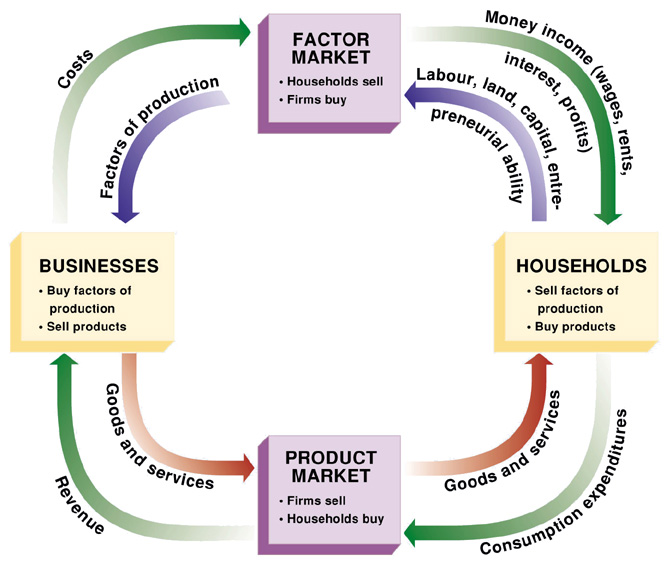
THE CIRCULAR FLOW DIAGRAM
Circular Flow Diagram: Represents the transactions in an economy.
Product Market: The place where households sell resources and businesses buy resources.
- Ex/: Goods and services
Factor/Resource Market: Holds factors of production- land, labor, capital, and entrepreneurship.
- The place where households sell resources & businesses buy resources.
- Firms purchased are rent land & higher workers
- The place where households sell resources & businesses buy resources.
- Firms purchased are rent land & higher workers
Firms: -An organization that produces goods and services for sale.
-sell finished products to households.
Household: - A person or group of people that share their income.
-Sell their factors of production to businesses.
(1/27/16) - (1/28/16)
GDP
GDP
Gross Domestic Product (GDP): Market product of all final goods and services produced within a country's borders within a given year.
Gross National Product (GNP): The total value of all final goods and services by citizens of that country on its land/foreign land.
What's not included in GDP?
1. Intermediate goods (goods that require further processing before they are ready for final use.)
2. Used/Second hand goods (avoid double counting)
3. Purely financial transaction (stocks and bonds)
4. Illegal Activities (Drugs)
5. Unreported business activity (unreported tips)
6. Transfer payments -Public (SS, welfare, VA)
-Private (scholarships)
7. Non-Market Activity -volunteer work
-babysitting
-any work that you perform yourself.
-producing own source of labor.
What's Included in GDP?
1. C - Personal Consumption Expenditures (wages, salaries)
2. Ig - Gross Private Domestic Investment: - New Factory equipment
- Factory equipment maintenance
- Construction of housing
- Unsold inventory (of products built in a year)
3. G - Government Spending
4. Xn - Net Exports (exports - imports)
(1/29/16)
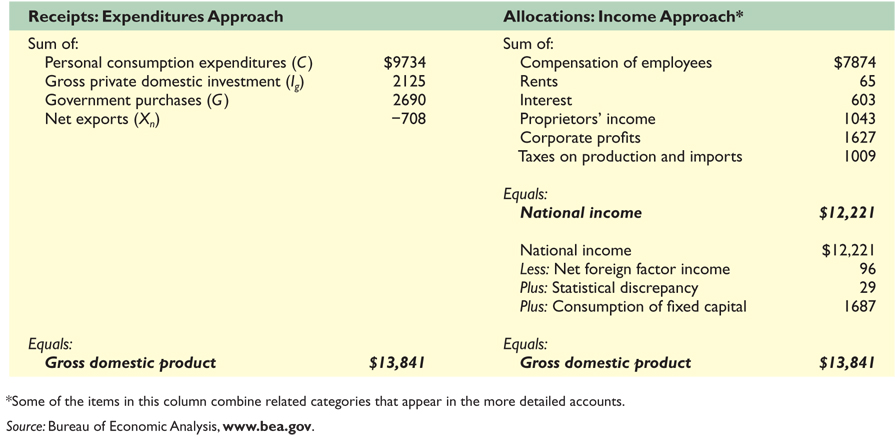
2 Ways of Calculating GDP:
1. Expenditure Approach: Add up all of the spending on final goods and services
produced in a given year.
Formula: GDP = C + Ig + G + Xn (exports - imports)
produced in a given year.
Formula: GDP = C + Ig + G + Xn (exports - imports)
2. Income Approach: Add up all of the income that resulted from selling all final
goods and services produced in a given year.
Formula: GDP = W (wages) + R (rents) + I (interest) + P (profits) + Statistical Adjustments
* Statistical Adjustments include 1.) Indirect business taxes
2.) Depreciation (Consumption of fixed capital)
3.) Net foreign factor payment
National Income:
- Compensation of Employees: wages, salaries, fringe benefits, SS contributions,
health pension plans.
- Rents: Income of property owners.
- Interest: Income that is paid by someone to the owner of a loan.
- Corporate Profits: Income of a stockholder in a corporation.
- Proprietors Income: Income of a sole proprietor (entrepreneur) or from a partnership.
2.) Depreciation (Consumption of fixed capital)
3.) Net foreign factor payment
National Income:
- Compensation of Employees: wages, salaries, fringe benefits, SS contributions,
health pension plans.
- Rents: Income of property owners.
- Interest: Income that is paid by someone to the owner of a loan.
- Corporate Profits: Income of a stockholder in a corporation.
- Proprietors Income: Income of a sole proprietor (entrepreneur) or from a partnership.
FORMULAS:
Budget Surplus(-)/Deficit(+) =
Gov. purchases of goods/services + Gov. transfer payments - Gov. tax/fee collection
Trade Surplus(+)/Deficit(-) =
Exports - Imports
National Income =
Compensation of employees + Rents + Interest + Corporate Profits + Proprietors Income
OR
GDP - Indirect business taxes - Depreciation - Net foreign factor payment
Disposable Personal Income =
National Income - Personal Household taxes + Gov. transfer payments
(2/1/16)
MORE FORMULAS:
Net Domestic Product (NDP) = GDP - Depreciation
Net National Product (NNP) = GNP - Depreciation
GNP = GDP + Net Foreign Factor Payment
-Nominal GDP: The value of output produced in current prices.
- CAN increase from year to year if either output or prices increase.
- Formula: P(price) x Q(quantity)
-Real GDP: The value of output produced in constant or base year (earliest year) prices.
- Adjusted for inflation
- CAN increase from year to year ONLY if output increases.
- Formula: P(base yr price) x Q(current year quantity)
* If we want to measure ECONOMIC GROWTH we use Real GDP.
* If we want to measure INFLATION (increase in prices) we use Nominal GDP.
EX./
Q in 2015 Q in 2016 P in 2015 P in 2016
Pizzas 5 6 $10 $15
CDs 4 5 $15 $20
Stereos 2 4 $600 $550
Automobiles 1 1 $10,000 $12,000
Real GDP in 2015: $11,310
2016: $12,535
Nominal GDP in 2015: $11,310
2016: $14,390
- Formula: Nominal GDP/Real GDP x 100
-In the base yr, GDP Deflator will ALWAYS = 100.
- Years after the base yr, GDP Deflator is > 100.
- Years before the base yr, GDP Deflator is < 100.
- Consumer Price Index (CPI): - The most commonly used measurement for inflation.
- Measures the cost of a market basket of goods for a
typical Urban American Family.
Formula: Cost of a market basket of goods in a given yr/Cost of a market basket of goods in base yr x 100
- Inflation: (Price Index in yr. 2 - Price Index in yr. 1)/Price Index in yr. 1 x 100
(2/2/16)
REAL INTEREST RATE V. NOMINAL INTEREST RATE
Real Interest Rate: The % increase in purchasing power, the borrower MUST pay the lender a loan.
- IS adjusted for inflation.
- Unanticipated Inflation (not expected)
- Formula: Real Interest Rate = Nominal interest rate - Inflation
Nominal Interest Rate: The % increase in money, the borrower MUST pay the lender for a loan.
- NOT adjusted for inflation.
- Anticipated Inflation (expected)
* Fisher effect: Nominal Interest Rate = Expected interest rate + Inflation premium
Hurt by Inflation | Helped by Inflation
1) Savers 1) Debtors (owe $)
2) Creditors/Lenders
3) Those who are on a
fixed income.
- elderly
- welfare
- medicaid
- retired
* COLA (Cost Of Living Adjustment) - gives automatic wage increases when inflation occurs.
(2/4/16)
Unemployment: failure to use available resources particularly labor
to produce desired goods and services.
- NOT THE SAME as underemployment
Labor Force: - Above 16 yrs. of age.
- Able: willing to work
- Employed + Unemployed
NOT in Labor Force:
1) Military
2) Students
3) Retired
4) Disabled
5) Homemakers (stay @ home parent)
6) Ppl in mental institutions
7) Jail/ Prison
8) Those not seeking a job
Unemployment Rate: 4 to 5%
- Formula: # of unemployed/(# of employed + # of unemployed) x 100
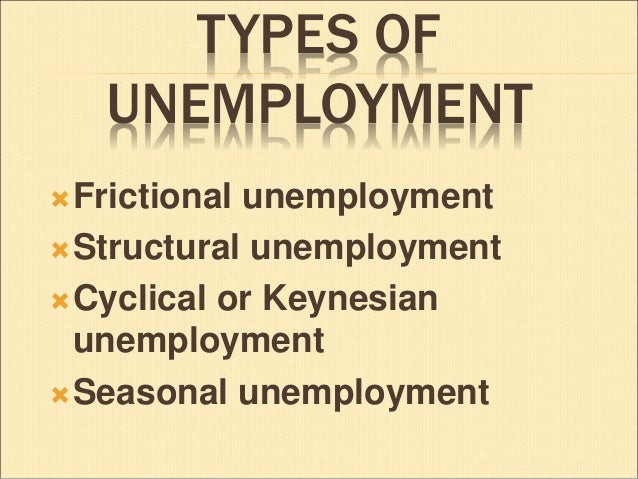
TYPES OF UNEMPLOYMENT:
1) Frictional unemployment: - searching for a job.
- temporarily unemployed or in between jobs.
- Ppl in this have TRANSFERABLE SKILLS.
- Unavoidable
- Ex./ better opportunity, high school/college graduate
2) Structural unemployment: - Changes in the structure of the labor force which
makes some skills and jobs obsolete.
- They DO NOT have transferable skills.
- Unavoidable
- Ex./ Nasa workers (specifically trained to build spaceships)
3) Seasonal unemployment: - Depends upon the time of the year & nature of the job.
- Ex./ bus drivers~only work when school in session
life guards~only summer time
contractors~only when weather is pleasant
4) Cyclical unemployment: - Results from economic downturns such as a RECESSION.
- As demand for goods/services falls, demand for labor ALSO falls
and workers are LAID OFF.
* Frictional + Structural = Natural Rate of Unemployment
* Full employment = NO cyclical unemployment
(2/5/16)
GDP Gap: The amount by which actual GDP falls short of potential GDP.
Okun's Law: For every 1% in which actual unemployment rate exceeds the NRU,
a GDP gap of about 2% exists.
EX./ In 2012, the unemployment rate for Mexico was 7.4%, the NRU
for Mexico is 6%, GDP Gap = 7.4 - 6 = 1.4 (x2) = 2.8% loss of potential GDP.
Rule of 70: Used to determine how many years it takes for a value to double
given a particular annual growth rate.
EX./ If you put &20,000 in the bank & it earns a yearly interest of 7%,
how many years will it take for your income to double? 70/7 = 10 yrs.
1) Frictional unemployment: - searching for a job.
- temporarily unemployed or in between jobs.
- Ppl in this have TRANSFERABLE SKILLS.
- Unavoidable
- Ex./ better opportunity, high school/college graduate
2) Structural unemployment: - Changes in the structure of the labor force which
makes some skills and jobs obsolete.
- They DO NOT have transferable skills.
- Unavoidable
- Ex./ Nasa workers (specifically trained to build spaceships)
3) Seasonal unemployment: - Depends upon the time of the year & nature of the job.
- Ex./ bus drivers~only work when school in session
life guards~only summer time
contractors~only when weather is pleasant
4) Cyclical unemployment: - Results from economic downturns such as a RECESSION.
- As demand for goods/services falls, demand for labor ALSO falls
and workers are LAID OFF.
* Frictional + Structural = Natural Rate of Unemployment
* Full employment = NO cyclical unemployment
(2/5/16)
GDP Gap: The amount by which actual GDP falls short of potential GDP.
Okun's Law: For every 1% in which actual unemployment rate exceeds the NRU,
a GDP gap of about 2% exists.
EX./ In 2012, the unemployment rate for Mexico was 7.4%, the NRU
for Mexico is 6%, GDP Gap = 7.4 - 6 = 1.4 (x2) = 2.8% loss of potential GDP.
Rule of 70: Used to determine how many years it takes for a value to double
given a particular annual growth rate.
EX./ If you put &20,000 in the bank & it earns a yearly interest of 7%,
how many years will it take for your income to double? 70/7 = 10 yrs.

I liked that you included graphs with to show examples on how to use the equations. Also the video made the concept easier to understand.
ReplyDeleteYou were one of the few people who included examples and it really helped make things clear, and also for nominal GDP instead of just having price x quantity, perhaps it should instead be current year x current quantity. But i might be wrong though, food for thought.
ReplyDeleteThe formulas are really helpful!
ReplyDelete